Service and life
John Shaw Simon grew up in Birkenhead. In his oral history he remembers his family, his schooling and his father’s reaction when he was looking for work in shipbuilding. He joined the Territorial Army at Aigburth, Liverpool, on 16 March 1938 and served as a gunner with the 70th (3rd West Lancashire) Heavy Anti-Aircraft Regiment, Royal Artillery.
In 1940 Simon served at Scapa Flow, where he recalled German raids on Royal Navy ships. Later that year he helped defend factories around Manchester. He also remembered seeing the Cammell Laird shipyard under attack while home on leave in Tranmere in May 1941. In March 1942 he sailed for India, where he served with 212th Heavy Anti-Aircraft Battery.
Simon volunteered for Special Force in August 1943 and trained as infantry at Jhansi. During Operation Thursday in 1944 he served as a private with 99 Headquarters Column of Brigadier Bernard Fergusson’s 16th Infantry Brigade. The brigade included the 2nd Leicesters’ 17 and 71 Columns. Simon recalled the march from the Ledo Road over the Naga Hills to the Chindwin and the building of the Aberdeen landing ground. He contracted malaria in Burma and was flown out from Aberdeen.
In the third reel of his 1997 interview, Simon recalls an aircraft accident during the evacuation of the 2nd Leicesters. His Army tracer card records a later transfer to the Essex Regiment.
How we confirmed his service
His Royal Artillery tracer card records his posting to 51/69 Regiment, Royal Artillery, on 29 January 1944. In his Imperial War Museums interview, Simon describes serving with 99 Headquarters Column during Operation Thursday and being evacuated from Aberdeen after contracting malaria.
Photographs
Sources
- Imperial War Museums, interview with John Shaw Simon, 1 October 1997, Sound 17604 (three reels)
- Royal Artillery tracer card for John Shaw Simon, Army no. 881390.
- Chindit order of battle, 16th British Infantry Brigade
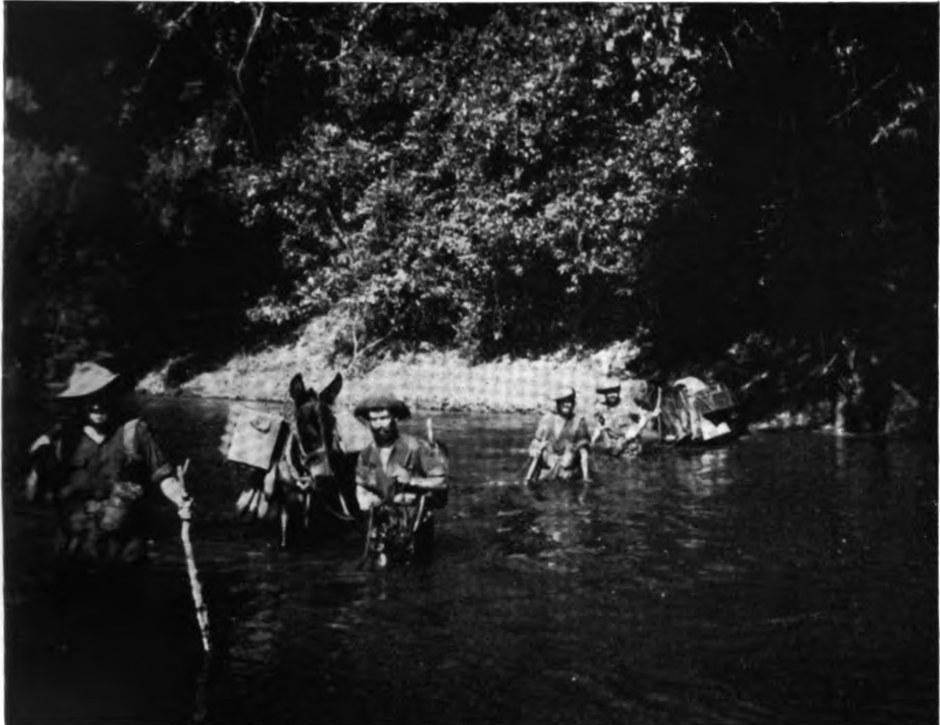
- The Queen’s Royal Regiment Journal, May 1947, p. 16, river-crossing photograph